

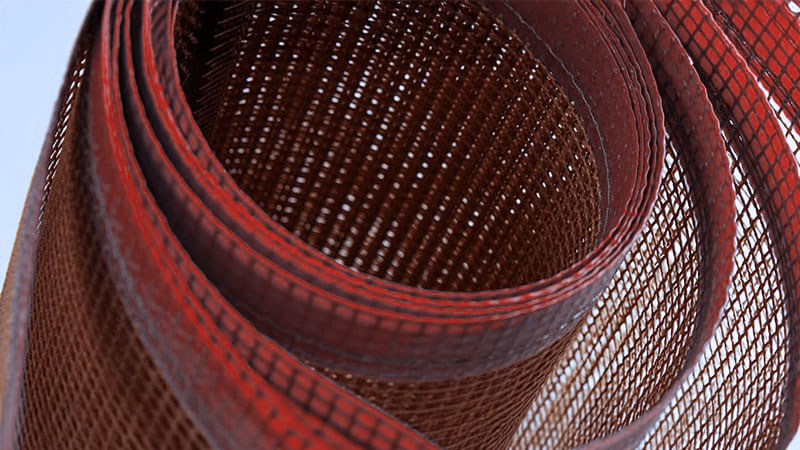
In industrial production, many processes depend on two things happening at the same time: controlled heat and consistent airflow. When you are drying coated parts, dehydrating food, or curing inks and adhesives under UV lamps, the conveyor surface becomes part of the process itself. It influences heat transfer, moisture escape, line speed, product release, and ultimately, quality.
PTFE mesh belts are widely used in these environments because they combine high heat resistance, chemical inertness, and excellent airflow permeability in a single belt construction.
In practical terms, this means manufacturers can run more consistent results at production speed, reduce sticking and cleanup issues, and maintain stable tracking in continuous lines, even when temperatures and process conditions fluctuate.
Key Takeaways
- PTFE mesh belts directly affect process results because their open structure controls how air, heat, and moisture move around the product.
- A typical PTFE mesh belt uses fiberglass mesh for strength and dimensional stability, coated with PTFE for a smooth, easy-release surface. The mesh opening is selected to balance product support with airflow and energy transmission.
- A non-stick, low-friction PTFE surface reduces buildup from inks, resins, adhesives, and food sugars, which helps minimize marking, pickup, scraping, and cleanup between runs.
- Chemical resistance of the PTFE helps belts maintain performance when exposed to oils, solvents, acids, and routine cleaning agents.
- Open-mesh design supports UV curing because it lets UV light reach the product through the belt and reduces shadowing, while PTFE resists UV and heat during long shifts.
Quick Links
- About PTFE Mesh Belts
- Key Characteristics That Make PTFE Mesh Ideal for Drying & Curing
- How PTFE Mesh Belts Improve Drying Processes?
- Role of PTFE Mesh Belts in Industrial Dehydration
- How PTFE Mesh Belts Support UV Curing Applications
- Choosing the Right Mesh Size for Drying, Dehydration, or UV Curing
- Temperature and Chemical Performance in Harsh Processes
- Edge Reinforcements, Splices & Custom Fabrication Options
- Industries That Use PTFE Mesh Belts for Drying and Curing
- How to Select the Best PTFE Mesh Belt for Your Process
- Conclusion
About PTFE Mesh Belts
A PTFE mesh conveyor belt is typically made from an open fiberglass mesh that’s coated with PTFE (polytetrafluoroethylene). The fiberglass provides strength and dimensional stability, while the PTFE layer gives you a smooth, easy-release surface suited to heated process lines.
The open-weave structure is defined by its mesh opening. Standard available options include 1 mm, 2 mm, and 4 mm meshes, which you can choose based on your requirements. In operation, a PTFE mesh belt—often specified as a PTFE-coated mesh belt—lets hot air and radiant energy pass through the belt, reaching the product more evenly. The mesh size can be adjusted to balance contact area, heat transfer, and moisture release.
Benefits for drying, dehydration, and UV curing
- Non-stick release reduces ink, resin, and food buildup on your PTFE-coated mesh belt.
- High airflow through PTFE mesh belts speeds drying, dehydration, and solvent evacuation in your tunnels.
- High temperature resistance supports continuous operation near 260°C, depending on your process specification.
Key Characteristics That Make PTFE Mesh Ideal for Drying & Curing
Can a conveyor belt really influence curing quality and drying speed? With the right PTFE mesh conveyor belt, you can control airflow, heat exposure, and clean release. Here are some of the key characteristics of PTFE-coated mesh belts.
Temperature Margin for Reliable Operation (to 260°C)
A PTFE mesh conveyor belt is built to run continuously up to about 260°C, which aligns with many industrial dryers, IR heaters, and UV/IR hybrid systems. This heat headroom helps you hold setpoints without surface breakdown, supporting repeatable curing and fewer belt-related changeovers.
Open-Weave Permeability
With a PTFE open-mesh conveyor belt, you’re not trapping moisture under the product; the open area lets hot air move through and vapour escape efficiently. On an industrial drying conveyor, permeability improves uniformity across the belt width and can reduce drying time compared to closed surfaces.
Non-Stick Surface
PTFE provides a low-friction, non-stick surface that supports clean release from inks, coatings, adhesives, and many food items. The practical benefits of the PTFE-coated mesh belt include fewer marks, less pickup, and simpler cleaning between runs.
Chemical Resistance
In many industrial plants, belts are exposed to oils, acids, solvents, and routine cleaning chemicals. PTFE is widely valued for its inertness to most chemicals, helping a conveyor belt maintain surface performance in harsh environments. For procurement teams, this often translates into longer service life and more predictable maintenance planning.
Dimensional Stability
The fiberglass reinforcement in PTFE belting supports strength and dimensional stability under heat and tension. It is critical when you need stable tracking and consistent dwell time. This is why many teams treat PTFE as a high-performance belting material for curing lines where repeatability matters.
How PTFE Mesh Belts Improve Drying Processes?
When you’re trying to dry a coating, ink, food slice, or a washed part, the primary resistance is trapped moisture. A PTFE mesh conveyor belt solves that in a very practical way: its open weave lets hot air move through the belt, not just over the top. That means airflow reaches the underside of your product, giving moisture a direct escape route, which supports more even drying across the full width of the line.
Because the belt is permeable, you can often improve moisture removal and shorten drying time without raising the temperature or extending the oven time. The PTFE coating provides you a smooth, non-stick release surface that helps you reduce pickup, smearing, and scorch marks.
Finally, the open mesh supports consistent heat exposure along the belt path. We at MPI Matco recommend PTFE-coated mesh belts for uniform heat distribution. It is useful when you’re tuning dwell time on an industrial drying conveyor or specifying a PTFE conveyor belt for production stability.
Role of PTFE Mesh Belts in Industrial Dehydration
Dehydration is essentially controlled drying with tighter quality expectations. Products must lose moisture without collapsing, sticking, overheating, or developing inconsistent texture. and airflow is central to that outcome. Because dehydration performance depends heavily on both heat input and moisture removal, airflow and belt design become central to process control.
Why dehydration needs heat and airflow
In dehydration, heat alone is not enough. Heat helps water turn into vapour, while airflow helps in carrying those vapours away. If the air stays still, moisture builds up around the product. Drying slows down, and results become uneven.
How mesh belts perform in food dehydration
Food dehydration needs steady handling and repeatable results. Fruits, vegetables, and herbs can shrink, curl or become fragile as they dry. A PTFE coated fiberglass mesh belt supports the product while still leaving space around it. MPI Matco offer different mesh openings so you can match the belt to the size of the product. That helps reduce product loss and keeps ingredients more consistent.
Non-Stick release for delicate products
Some dehydrated products can stick during dehydration. Fruit can become tacky because of natural sugars. Thin herbs can cling and tear during transfer. A teflon mesh conveyor belt gives you easier release at the end of the line. It also reduces the need for scraping. That means less damage and less waste.
Sanitary and food-safe benefits
Food lines need clean equipment. PTFE-coated fiberglass materials are widely used because they are easy to wipe down and do not absorb moisture. They also help reduce buildup and carryover between batches. For teams specifying PTFE belting, this supports simpler cleaning routines and better hygiene control.
How PTFE Mesh Belts Support UV Curing Applications
When you’re running a UV curing line, the open-mesh design of PTFE (Teflon) mesh belts offers a real advantage. It lets ultraviolet light pass through without blocking the energy needed to cure inks, coatings, or adhesives on your products. Because PTFE itself is highly resistant to ultraviolet exposure and heat, the belt won’t degrade or warp even after long shifts under intense UV lamps.
This is why we see these belts used in UV printing tunnels, PCB manufacturing, coating lines, and high-speed curing conveyors where consistent cure quality and uptime matter most. The combination of airflow, dimensional stability, and UV tolerance helps you boost throughput and reduce downtime.
Choosing the Right Mesh Size for Drying, Dehydration, or UV Curing
Open-mesh PTFE belts typically come in sizes such as 1×1mm, 2×2.5mm, and 4×4mm, with larger options (6–10mm) also available, depending on airflow and product needs. Smaller meshes offer finer support, while larger meshes give more open area for air and light transmission.
Here is how mesh size affects different elements:
- Airflow: the 1×1 mm mesh offers minimal airflow but is ideal for supporting small, lightweight products. In contrast, a 4×4 mm mesh maximizes airflow, allowing fast drying in high-heat applications, such as textile or food drying.
- Light transmission: for UV curing lines, larger mesh sizes let more UV light reach the product through the belt, enhancing cure consistency without shadowing. Smaller meshes may block more light but support thin or delicate materials better
- Mechanical Strength: smaller meshes (1x1mm) tend to be stronger and are ideal for supporting fragile products or those subjected to mechanical stress. Larger meshes, such as 4×4 mm or 6x6mm, are better suited for bulkier products but may need additional reinforcement for heavy-duty use.
- Product support: if you’re conveying small parts or thin films, a 1×1mm mesh prevents product sagging or falling through. For bulkier or robust items, 2×2.5mm to 4×4mm works well, balancing support with airflow/light access.
Recommendations by Application Type
- For fine dehydration or lightweight drying, choose a 1×1 mm mesh for secure product handling.
- For UV curing or textile drying, a 2×2.5 mm or 4×4 mm mesh strikes the right balance of airflow, light transmission, and strength.
- For high-speed drying, a 6 mm mesh maximizes airflow.
Always consult a reliable PTFE conveyor belt manufacturer for tailored advice.
Temperature and Chemical Performance in Harsh Processes
PTFE mesh belts are frequently specified for lines where heat, chemicals, and continuous operation would degrade conventional conveyor materials. Their performance is driven by the combination of a fiberglass reinforcement layer and a PTFE coating, which together deliver predictable behaviour under temperature cycling and exposure to process chemistry.
Operating Temperature Range and Thermal Cycling Tolerance
PTFE mesh conveyor belts can withstand extreme temperatures, typically from -70°C to +260°C. In addition to peak operating temperature, engineers should evaluate:
- Thermal cycling frequency (start/stop operations, shift changes, washdowns)
- Ramp rates (how quickly the system heats and cools)
- Tension stability at temperature (belt elongation behaviour and tracking)
Thermal cycling is often where lower-grade materials fail first. A properly specified PTFE mesh belt maintains dimensional stability and consistent tracking behaviour.
Resistance to Oils, Solvents, Cleaning Agents, and Corrosive Agents
PTFE is valued for broad chemical inertness, which helps in processes involving:
- Oils and plasticizers
- Solvents and coatings chemistry
- Cleaning agents used for routine sanitation
- Acidic or alkaline residues in certain industrial environments
In practical terms, this chemical resistance reduces belt swelling, softening, or surface breakdown that can lead to contamination, product marking, and premature failure. The key is to match belt specification to the reality of exposure: intermittent wipe-down is different from constant chemical contact, and hot chemical exposure is more aggressive than room-temperature contact.
When to Choose Standard PTFE vs Anti-Static PTFE Mesh
Standard PTFE mesh is appropriate for most drying, dehydration, and curing lines where static is not a primary operational constraint. However, we recommend using an anti-static PTFE mesh belt when static accumulation may contribute to problems such as:
- Lightweight products lifting, shifting, or clinging to the belt
- Dust attraction or contamination in finishing environments
- Static-related handling issues near sensors or control components
- Processes where static discharge is undesirable due to product sensitivity
Anti-static options are typically specified to improve handling consistency and reduce nuisance issues in high-speed, low-humidity lines, particularly when conveying films, light substrates, or coated materials.
Edge Reinforcements, Splices & Custom Fabrication Options
When selecting a PTFE mesh conveyor belt, pay attention to the edges, splices, tracking characteristics, and dimensional tolerances. These elements often determine whether a belt will operate reliably at production speed or become a recurring maintenance issue, especially in long heated tunnels and continuous curing lines.
Because belt edges are high-stress zones, they are commonly finished with PTFE-coated Kevlar® reinforcement, fiberglass reinforcement, or sealed/coated edges to reduce fraying, improve tear resistance, and support easier cleaning. The right edge choice depends on tension, conveyor geometry, and whether the belt contacts guides or frame components that can introduce abrasion.
Splice and fabrication choices then complete the system fit. Depending on maintenance needs and line conditions, belts may use mechanical splices, endless constructions, or reinforced splice designs for higher tension and speed. Tracking reliability is often improved through guides (where compatible) and custom widths/tolerances to match rollers and airflow plenums. In drying and UV curing, these custom details matter because small deviations can create tracking drift, inconsistent exposure, and uneven results across the belt.
Industries That Use PTFE Mesh Belts for Drying and Curing
Ever wondered where PTFE mesh conveyor belts really make a difference in real-world operations? Here’s a look at where they’re commonly used:
- Food processing: From dehydrators to ovens, PTFE mesh belts promote hot-air circulation, making them ideal for drying and baking without sticking.
- Plastics and rubber curing: Resists heat and chemical exposure, ensuring stable curing and processing of plastic and rubber parts.
- Textile and screen printing: PTFE-coated mesh belts are used for rapid drying in textile and screen printing processes, promoting uniform heat distribution.
- UV curing lines: These belts allow UV and IR light to pass through for precise curing of inks, coatings, and adhesives.
- Electronics manufacturing: PTFE mesh belts support PCB adhesive curing and other electronic component drying processes, offering thermal stability and precision.
- Chemical filtration and drying systems: The PTFE belts are used to resist corrosive environments and facilitate efficient drying and solvent removal.
Across all these industries, Teflon mesh conveyor belts provide optimized airflow, thermal resistance, and chemical durability.
How to Select the Best PTFE Mesh Belt for Your Process
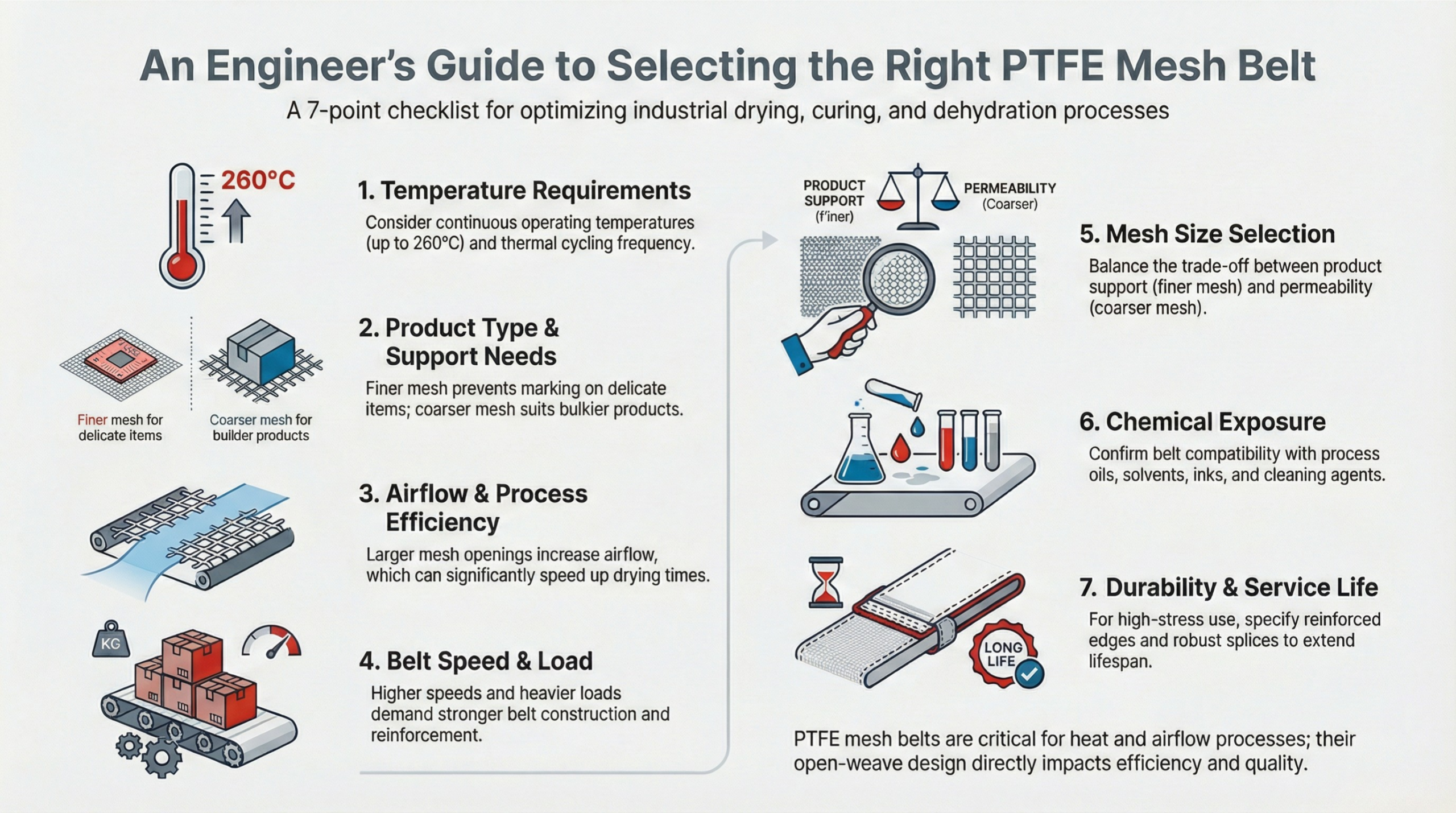
Selecting the right PTFE mesh belt comes down to matching the belt to your process conditions and your product behaviour on the line. A good selection will improve drying or curing consistency, reduce sticking, and minimize tracking and maintenance issues.
1) Temperature Requirements
Start with the operating temperature of your oven, dryer, or curing tunnel, including any start/stop cycles. Most high-quality PTFE mesh belts withstand continuous heating up to about 260°C, and some tolerate thermal cycling without losing integrity — critical in ovens and dryers.
2) Product Type and Support Needs
Your product determines how much support the belt must provide. Lightweight or delicate materials, such as textiles and screen-printed substrates, typically require a finer mesh to prevent marking, sagging, or distortion, while bulkier goods tolerate larger openings. Mesh choice affects product support and heat/air contact.
3) Airflow and Process Efficiency
Mesh openness directly affects airflow through the belt, which influences drying and moisture removal. Larger mesh sizes allow for greater airflow, speeding drying in high-volume lines.
4) Belt Speed and Load
Line speed and load drive the mechanical demands on the belt. Heavier loads and higher speeds typically require a stronger construction and often more reinforcement at the edges and splice. A 1×1 mm mesh supports lighter loads, up to 5–10 kg/m² at moderate speeds (~1–3 m/min), while a 4×4 mm mesh handles heavier loads, up to 50–80 kg/m², at higher speeds (~5–10 m/min). Always consult manufacturer specs for precise ratings.
5) Mesh Size Selection
Common mesh options (for example, 1×1 mm, 2×2.5 mm, and 4×4 mm) represent different trade-offs between support and permeability. As a rule:
- Finer mesh = more support, less airflow/light transmission
- Coarser mesh = more airflow/light transmission, less support
6) Chemical Exposure and Cleaning Agents
If your process involves inks, coatings, adhesives, solvents, oils, or aggressive cleaning agents, confirm compatibility with your PTFE conveyor belt provider to prevent degradation. PTFE offers strong chemical resistance, but real-world performance depends on exposure time, temperature, and the specific chemicals used.
7) Durability and Expected Service Life
Finally, consider run hours, maintenance intervals, and wear points (edges, splice, guides). In higher-stress environments, belts with reinforced edges and robust splice construction typically deliver longer service life and fewer unplanned changeovers.
Engineer’s quick checklist
- Operating temperature and thermal cycling
- Product support requirements
- Airflow needs vs mesh openness
- Expected conveyor line speed, load, and tension limits
- Chemical exposure and cleaning routine
If you’re still unsure, our engineers can help you make the right PTFE belt choice for your process.
Conclusion
Now you know that PTFE mesh conveyor belts are indispensable for industries requiring consistent performance under demanding conditions. Whether it’s drying, dehydration, or UV curing, their temperature tolerance, airflow efficiency, and chemical resistance ensure reliable results. With options for custom fabrication, mesh size, and reinforced edges, these Teflon belts offer tailored solutions for smooth, efficient operations across a range of industrial applications.
MPI Matco is a provider of custom PTFE conveyor belts for many manufacturing needs. If you want or think you can boost your production efficiency with a custom PTFE mesh belt built for your application, request a consultation with one of our experts today.


