


Are you confident that your adhesive tape converter aligns with...
READ MORE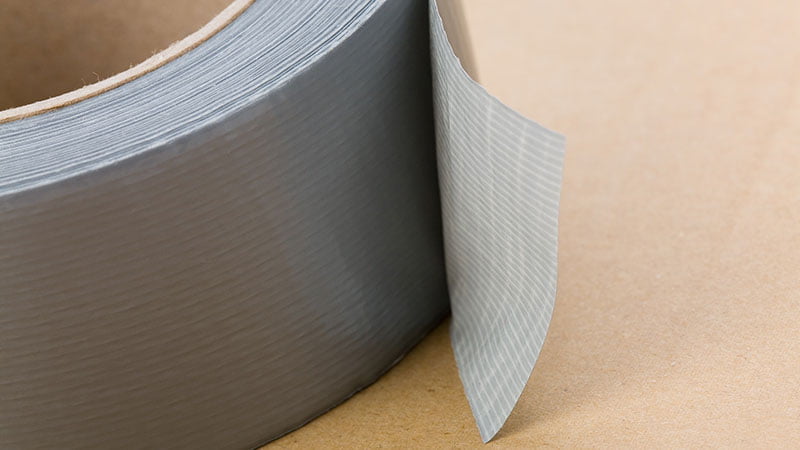
Different Types of Duct Tape – Are You Using the Right Type?
Duct tape is a very popular type of tape due to its versatility. But, unlike what many think, they’re not necessarily one-size-fits-all. The backing, adhesive, temperature range, and removability you need vary by job, whether you’re sealing HVAC, masking concrete, managing stage cables, or tackling industrial repairs. As industrial adhesive tapes experts drawing on our experience with application engineering, product testing, and day-to-day field support, this guide clarifies when to use general, professional, and industrial grades, when gaffer tape is the smarter choice, and when foil tapes are required. Use it to specify confidently and avoid costly failures.
Key Takeaways
- Duct tape isn’t one-size-fits-all; the backing, adhesive strength, temperature range, and how cleanly it removes should match the job to prevent failures and rework.
- General-purpose duct tape is best for inexpensive, short-term fixes because it uses a lower fabric count, lighter adhesive, and thinner film, so it’s not suited for long-term service.
- Gaffer’s tape is a heavy cotton cloth tape made for temporary staging and production needs, with a matte finish and clean removal that works well for cables, props, and quick ad hoc repairs.
- For demanding applications, step up to industrial or professional (contractor) duct tape grades for higher fabric count and adhesive.
The History & Evolution Of Duct Tape
Though a common household name for repair technicians in a myriad of industries, this tape was initially designed for the military as a replacement for paper tape and melted wax, which were used for sealing ammo cases. At the end of World War II, the tape found a lot of uses outside the military, and its popularity in the United States grew due to its versatility in home construction.
Over the years, the tape has undergone a myriad of changes in terms of design and construction, all aimed at making it suitable for a variety of applications. The initial design featured a strong fabric that was then bonded to a polythene film, to give it strong sealing and waterproofing capabilities. The common duct tape colour back then was silver-gray, not the black duct tape you are used to seeing presently. This was purposefully done, allowing it to match metal ductwork, upon which it started to become used extensively.
Currently, duct tape is available in multiple forms and designs, which are used for a variety of applications across multiple industries. Each available variety has specific features that make it suitable for applications in specific industries. As such, it pays to know about the different types of duct tape, so that you can choose the right one whenever you need to use it. Below is a brief look at the various types of duct tape, and the possible areas of application.
The Different Types of Duct Tapes & Their Applications
General Purpose Duct Tape
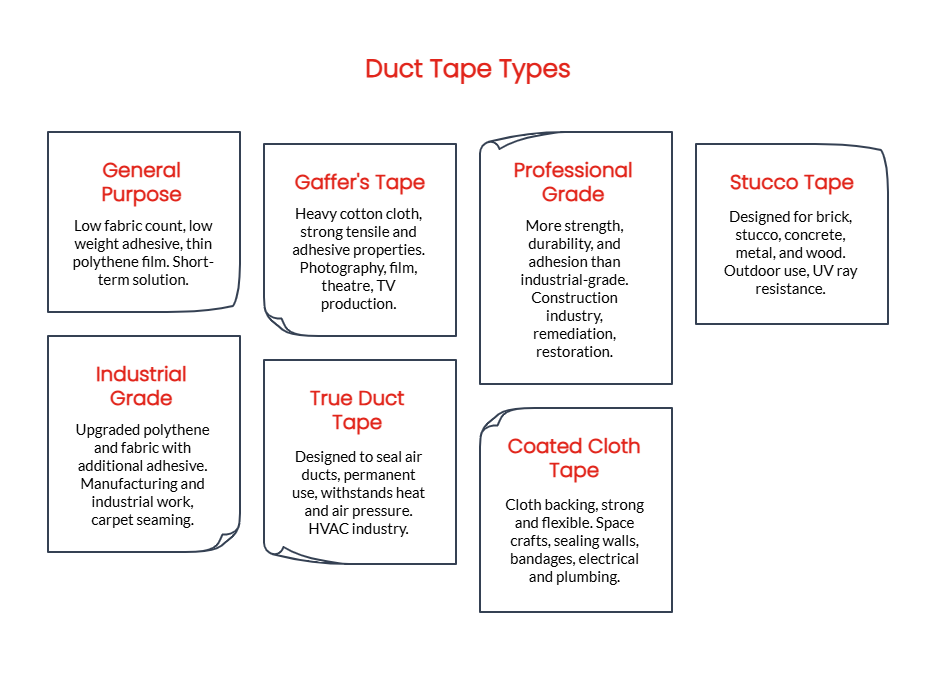
Just as the name suggests, you need this kind of duct tape for all kinds of odd applications. It features a low fabric count, low weight adhesive, and a very thin polythene film. If you are looking for a short-term solution that will later require a more long-term repair, then this is the most suitable type of duct tape to use. It isn’t ideal for applications where long-term service is needed.
Gaffer’s Tape
Gaffer’s tape is another common type of duct tape, one which you have probably encountered numerous times without realizing it. It is a heavy cotton cloth pressure-sensitive tape that has both strong tensile and adhesive properties. It is the preferred tape of choice for applications in photography, film, theatre, TV production and industrial staging works. Other than application in this industry, gaffer tape tends to be preferred where a quick ad hoc fix is needed for temporary purposes. That is why it is commonly seen when it comes to salvaging broken pieces of production equipment, and for attaching temporary fixtures or props in the film and photography industries.
Professional Grade Duct Tape
Professional grade duct tape is also known as “contractor” grade duct tape. It is a step higher than industrial-grade duct tape, and this means that they come with more strength, durability, and adhesion compared to industrial-grade tapes. Within this category, there are also other sub-categories of professional-grade tape, and they are primarily used in the construction industry – especially for remediation, restoration and abatement jobs within the building industry.
Stucco Tape
Stucco tape is designed for application on a wide variety of textures and materials, and it can be comfortably used on brick, stucco, concrete, metal, and wood without any compromise in terms of strength and durability. The name came about as a result of its use on doors and windows before the spraying of outer walls with stucco. Because it is designed for outdoor use for several days, it is not only strong and durable, but it has also been treated to resist degradation as a result of excessive exposure to ultraviolet rays.
Industrial Grade Duct Tape
Duct tape has a wide range of applications in manufacturing and industrial work. Of all the tape types, it is one of the few that has been developed to provide the strength and versatility desired in industrial setups. With industrial-grade duct tape, both the polythene and the fabric are upgraded with additional adhesive coating weight to offer the strength needed for industrial applications. A popular type of industrial-grade duct tape is the multicolored tape you will normally see at exhibitions being used to seam and hold carpets.
True Duct Tape
Just as the name suggests, true duct tape never disappoints, but this doesn’t mean that other tapes are somehow lower grade or knock-offs of some sort. These duct tapes were designed to seal air ducts, and they have done exceptionally well for this particular application. They are designed for permanent use, and they can withstand heat and air pressure for as long as the duct onto which they are applied is still in use. This category is top of the line, boasting high tensile strength and great reliability. It is a darling in the HVAC industry and a must-have tool in every HVAC technician’s bag. If you’re dealing with more extreme temperatures, foil tapes are better suited for these jobs.
Coated Cloth Tape
Coated cloth tape is also known as a “Mission Tape”, and this is perhaps attributed to the fact that it has found its way into outer space several times during the numerous U.S manned space launches. It was the tape that was used in the construction of carbon dioxide absorbers, believed to have rescued the lives of the scientists aboard the ill-fated Apollo 13 mission. The tape’s construction features a cloth backing, making it strong and flexible. Apart from its use in spacecrafts, it can also be used for sealing walls, as bandages, as well as throughout electrical and plumbing applications.
At a Glance: What Duct Tape to Choose
| Use case | Recommended tape | Why |
| Stage/film cabling (temporary) | Gaffer’s tape | Matte finish, clean removal |
| HVAC duct sealing | True duct tape | High-tensile strength and purpose-built for wider range of temperatures |
| High-temp HVAC duct sealing | Foil/UL-rated tape | Heat/pressure resistant; code-friendly |
| Outdoor stucco masking | Stucco tape | Short-term UV resistance |
| General repairs (short-term) | General purpose duct | Economical, easy tear |
| Heavy-duty/permanent | Industrial/Professional grade duct | Higher fabric count & adhesive |
Choosing the Right Type of Tape for the Job at Hand
Duct tape comes in many specialized forms, each engineered to meet specific application demands—from quick general-purpose fixes to high-performance industrial and HVAC uses. Whether you need the flexibility of gaffer tape for production environments, the UV resistance of stucco tape for outdoor work, or the unmatched durability of true duct tape for sealing air systems, choosing the right tape is crucial for efficiency and reliability. Understanding the differences between these tape types, especially in terms of adhesive strength, surface compatibility, and intended lifespan, ensures you get optimal results without unnecessary trial and error.
For expert advice on selecting the right duct tape or adhesive product for your needs, contact our adhesive tape specialists at support@mpi-matco.com. We’re here to help you make informed choices for professional and everyday applications alike.
Frequently Asked Questions
Is duct tape good for HVAC ducts?
Foil/UL-rated tapes are preferred for long-term sealing, heat and pressure resistance, and standards compliance; standard cloth duct tape isn’t ideal.
What’s the difference between gaffer’s tape and duct tape?
Gaffer uses a cloth backing and clean-removal adhesive for temporary use; duct tape uses a PE-backed construction with more aggressive adhesive for permanent/semi-permanent fixes.
Is duct tape safe for high-temperature applications?
Only specific high-temperature duct tapes are designed to withstand heat. Standard duct tape can soften, lose adhesion, or leave residue when exposed to elevated temperatures. Always check the manufacturer’s temperature rating.
How do I choose the right duct tape for my application?
Selecting the right duct tape depends on factors such as surface type, temperature exposure, indoor vs. outdoor use, load or stress requirements, and whether the application is temporary or semi-permanent.
Other Articles That May Interest You

Benefits of Working with an Adhesive Tape Converter
Adhesive tape converting involves converting rolls of adhesive tape into...
READ MORE
Understanding PSA Tape Technical Data Sheet
A tape technical data sheet can almost seem like a...
READ MORE