teflon coated fibreglass conveyor belt

PTFE-Coated Fibreglass Conveyor Belt Technical & Selection Guide

PTFE-coated fibreglass conveyor belts combine woven fibreglass reinforcement with a PTFE-coated surface for industrial conveying applications involving heat, continuous movement or materials that may adhere to conventional belt surfaces. Available constructions and configurations vary by conveyor system and operating conditions. 

Often referred to as Teflon-coated conveyor belts, PTFE conveyor belts are used in food processing, packaging, drying, heat sealing, garment processing and other industrial applications. MPI Matco supplies PTFE-coated fibreglass conveyor belts and can help you compare available constructions and configure a belt around the requirements of your conveyor system and production process.

DISCUSS YOUR APPLICATION WITH OUR TEAM

PTFE Conveyor Belts at a Glance

  • PTFE-coated woven fibreglass construction
  • Low-friction, non-stick conveying surface
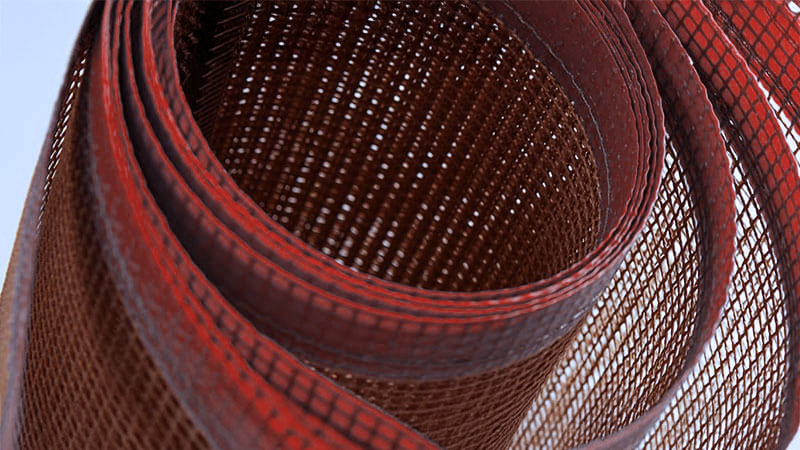
  • Open-mesh and solid constructions available
  • Suitable constructions for elevated-temperature processes
  • Resistance to many chemicals and moisture
  • Multiple joint and edge configurations
  • Custom belt dimensions and configurations available

What Is a PTFE-Coated Fibreglass Conveyor Belt?

A PTFE-coated fibreglass conveyor belt is made from woven fibreglass fabric coated with polytetrafluoroethylene (PTFE). The fibreglass provides reinforcement and dimensional stability, while the PTFE coating creates a low-friction release surface that contacts the material being conveyed.

The coated material is fabricated into a finished conveyor belt based on the equipment’s dimensions and operating requirements.

Main Properties of PTFE-Coated Fibreglass Belting

The performance of PTFE-coated fibreglass belting varies by base fabric, PTFE coating, thickness, mesh configuration and finished belt design.

Low Friction and Non-Stick Performance Temperature Resistance Dimensional Stability

The PTFE surface provides low friction and non-stick properties that can help reduce sticking and material buildup during processing.

PTFE-coated fibreglass constructions are available for elevated-temperature processes. Operating limits depend on the specific material and belt construction.

The woven fibreglass substrate reinforces the material and helps it maintain its dimensions during operation.

Chemical Resistance Resistance to Wear Low Moisture Absorption

PTFE resists many chemicals, oils and processing fluids, making PTFE-coated fibreglass belting suitable for a range of industrial processing environments.

The woven fibreglass reinforcement helps provide resistance to tearing, puncture and abrasion during repeated movement and contact.

PTFE absorbs very little moisture, which can be useful in humid, wet or frequently cleaned processing environments.

Understanding PTFE Conveyor Belt Constructions

The belt construction determines how the product is supported and how air, heat, and other process conditions interact with the material being conveyed.

Solid PTFE-Coated Fibreglass Conveyor Belts

Solid PTFE-coated fibreglass belts provide a continuous conveying surface. This construction is commonly used when full product support is required, when conveying smaller materials, or when the process does not require airflow through the belt.


The PTFE-coated surface also provides release properties that can be useful when conveying sticky, tacky or difficult-to-release materials.


Specifications can vary by thickness, coating, belt dimensions and finished configuration.

Open-Mesh PTFE Conveyor Belts

Open-mesh belts are made from PTFE-coated fibreglass arranged in an open grid. The mesh allows air and process heat to circulate through the belt and around the product, making this construction useful where air permeability is an important part of the process.


Different mesh openings are available depending on the required airflow and the size of the product being supported. Mesh opening and open area are therefore important specifications when selecting the appropriate belt construction.


For more information about applications where airflow is a key consideration, see our article on PTFE mesh conveyor belts.

Seamless and Joined PTFE Conveyor Belts

PTFE conveyor belts may be supplied as seamless constructions or fabricated to the required endless circumference using a joint or splice, depending on the belt type and application.


Where a joint is required, its design can affect surface profile, flexibility, installation and how the belt travels through the conveyor system.

Solid vs. Open-Mesh PTFE Conveyor Belts

Selection factor Solid belt Open-mesh belt
Product Size
Better for small/loose items
Product must suit mesh opening
Required airflow
Not a deciding factor
Often essential
Surface support
Full
Partial
Main specification focus
Thickness and coating
Mesh opening and open area

The choice between a solid and an open-mesh belt must be made taking into account other operating requirements such as temperature, load, belt dimensions, joint type and conveyor configuration.

Where Are PTFE Conveyor Belts Used?

PTFE-coated fibreglass conveyor belts are used in production processes where the conveying surface must withstand heat, promote product release, and support continuous movement or airflow.

Application Typical Belt Requirement
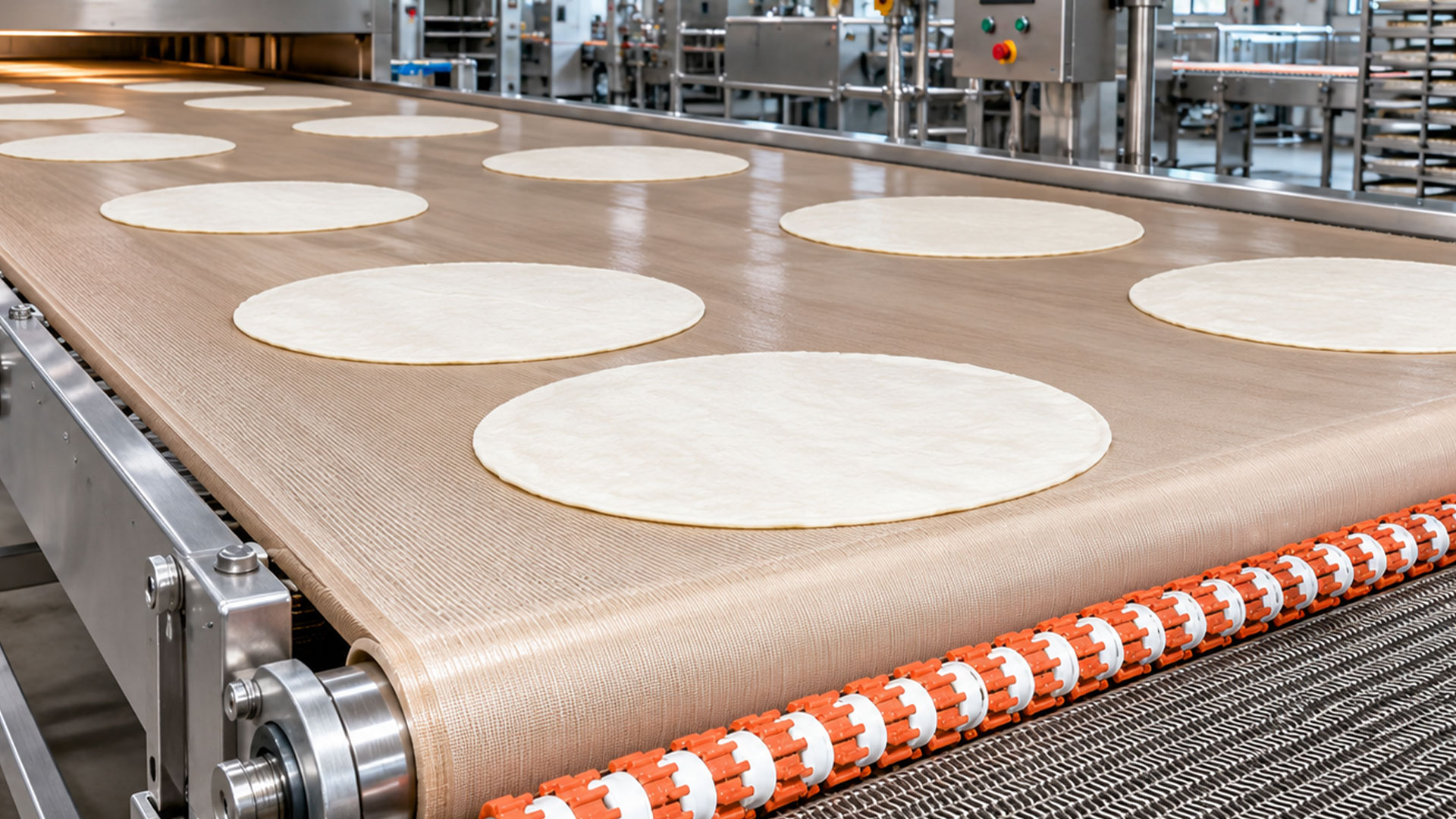
Food processing and baking

Release, temperature resistance and appropriate product support for items such as tortillas, flatbreads and baked goods

Drying and dehydration

Open-mesh construction to allow airflow through and around the product

Packaging and heat sealing

Heat resistance and release where films or packaging materials pass through heated sections of sealing equipment

Garment fusing

Stable conveying through heated pressing and fusing equipment

Rubber and polymer processing

Release properties for hot, tacky or difficult-to-handle materials

Industrial curing and processing
Belt construction suited to heat, airflow and product-support requirements

For a more detailed look at food-processing applications and other uses, see Introduction to PTFE Conveyor Belts in the Food Processing Industry.

Key Selection Factors for a PTFE-Coated Fibreglass Conveyor Belt

Selecting the right belt requires matching the construction to the product being conveyed and the conveyor system’s mechanical and operating conditions.

Key factors include:

  • Operating temperature: Normal operating temperature, short-term peaks, and heat-exposure duration.
  • Product characteristics: Product dimensions, weight, surface characteristics and whether materials are sticky, loose or difficult to release.
  • Belt construction: Solid or open mesh depending on product support and airflow requirements.
  • Mesh opening: For open-mesh belts, the opening needs to provide the required airflow while adequately supporting the product.
  • Load and operating conditions: Product load, belt speed and continuous mechanical demands can influence construction requirements.
  • Pulley and roller configuration: Roller dimensions and conveyor geometry can affect belt flexibility and available joint options.
  • Joint type: Surface profile, installation method and flexibility requirements can influence splice selection.
  • Edge and guiding requirements: Reinforcement, grommets, studs, or other guiding features may be required.
  • Operating environment: Chemicals, moisture, cleaning procedures and other process conditions should also be considered.

MPI Matco can review these factors with you and help compare PTFE conveyor belt constructions and configurations for your equipment and production process. 

GET HELP SELECTING A PTFE CONVEYOR BELT

PTFE Conveyor Belt Joint Options

The joint connects the belt ends to create the required endless circumference. Different joint designs are available depending on the belt construction, conveyor system and requirements for surface profile, flexibility and installation.

Heat Sealed Overlap​ Heat Sealed Butt Finger Splice

Heat Sealed overlap

Heat Sealed Butt

Finger Splice

The two belt ends overlap and are heat-sealed together. This creates a straightforward permanent joint, but the overlapping material produces additional thickness at the splice.

The belt ends meet rather than overlap, with a reinforcing layer heat-sealed beneath the joint. This provides a flatter surface than an overlap joint while maintaining reinforcement across the splice.

The belt ends are cut into interlocking fingers that are joined, reinforced and heat-sealed. The resulting joint provides a relatively flat, continuous conveying surface.

Alligator Splice Fabric Pin Splice

Alligator Splice

Fabric Pin Splice

An alligator splice uses metal lacing connected by a removable pin. This mechanical joint makes belt installation or removal easier when the belt must be opened. A protective cover flap may also be used depending on the application.

A fabric pin splice uses loops formed at each end of the belt and connected with a fibreglass or polyamide-imide (PAI) pin. The pin can be removed when the belt needs to be opened for installation or servicing.

PTFE Conveyor Belt Edge Reinforcement & Guiding Options

The edges of a PTFE conveyor belt can be finished or reinforced in different ways depending on the belt construction and conveyor requirements. Edge treatments can help protect the belt and accommodate guiding features where required by the equipment.
Sealed Sewn & Sealed Grommets (Eyelets) Domes / Studs

Sealed PTFEBelts2

SewnSealed PTFE Belts

Grommets Eyelets PTFEBelts

Domes PTFE Belts

The belt edge is sealed to create a finished edge and help protect the exposed fibreglass construction.

fdgfgffhfghgggfhjfgj

The belt edge is reinforced with stitching and then sealed. This provides additional reinforcement where the application requires a more robust finished edge.

Grommets can be incorporated into reinforced belt edges where the conveyor configuration requires eyelets as part of the belt design.

Domes or studs can be added along the belt edge where the conveyor system requires these features for its guiding configuration.

How to Specify a Replacement PTFE Conveyor Belt

When requesting a replacement belt, provide as much of the following information as possible: 

  • Finished belt width
  • Endless length or circumference
  • Solid or open-mesh construction
  • Mesh size or opening, where applicable
  • Belt thickness
  • Joint or splice type
  • Edge reinforcement
  • Location and spacing of grommets, domes, studs or other guiding features
  • Operating temperature
  • Product or material being conveyed

Photos, drawings, equipment specifications or a sample of the existing belt can also help MPI Matco identify and specify a replacement PTFE conveyor belt, including the required construction, dimensions, joint and edge configuration.

Share the Post:

Latest Articles

FAQ

Frequently Asked Questions

About PTFE Conveyor Belts

There is no single service-life estimate for a PTFE conveyor belt. Lifespan depends on belt construction, operating conditions, load, temperature, tracking and wear.

Premature wear can result from several factors, including excessive tension, poor belt tracking, unsuitable pulley dimensions, abrasion, damaged edges, excessive temperature or belt construction not properly matched to the application. Wear around the joint or belt edges can also indicate that the splice, reinforcement or guiding configuration should be reviewed.

A permanent splice creates a closed belt that stays joined during normal operation, while a removable mechanical splice lets you open the belt for installation or servicing. The appropriate option depends on the conveyor design, pulley configuration, surface requirements and how easily the belt can be installed or removed.

Scroll to Top