Industrial adhesive tapes are widely used to create reliable bonds between components. But what happens when a bonded part needs to be replaced during production, repaired during service, or separated for recycling at the end of a product’s life?
Removing a conventional permanent adhesive joint can be difficult and may damage surrounding components. This becomes particularly challenging when working with high-value parts or complex assemblies.
Debondable adhesive technologies offer a different approach: creating a durable bond that can also be released in a controlled way when required.
For manufacturers, this means considering both how components are bonded and how they can later be separated—to support rework, extend product life through repair, and facilitate material recovery.
What Is Debonding on Demand?
Debonding on Demand refers to adhesive technologies designed to maintain a reliable bond during normal use while allowing controlled separation when a specific release mechanism is activated.
While conventional removable tapes are often used for temporary applications, debondable bonding systems can be engineered for long-term use, with controlled removal when needed.
The appropriate solution depends on the substrates, assembly design, operating conditions, and intended removal process. Both bonding performance throughout the expected service life and the requirements for controlled removal should be considered when selecting a tape.
How Do Debondable Adhesive Technologies Work?
Different technologies use different mechanisms to release the bond. Examples described by tesa® include:
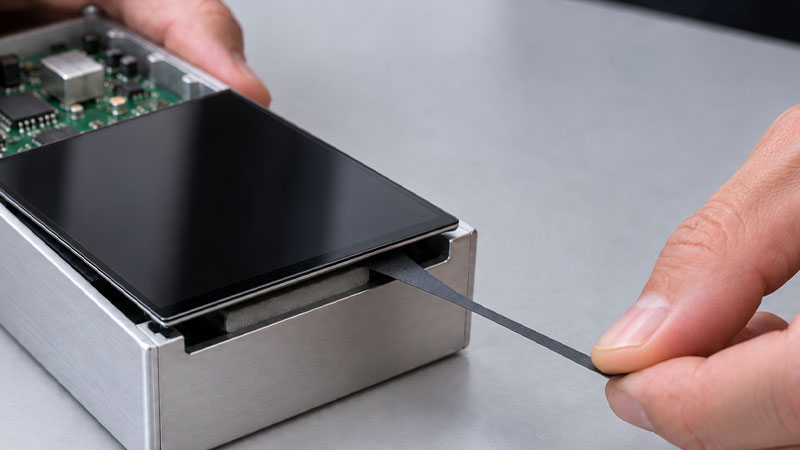
- Stretch release: Stretching the tape reduces its bonding strength, allowing removal through a controlled pulling action.
- Thermal debonding: Heat activates changes in a specially designed adhesive system that allow separation.
- Electrical debonding: An applied voltage triggers electrochemical reactions that enable release.
- Laser debonding: Laser energy weakens a specially designed tape structure to enable separation.
These mechanisms are not interchangeable. Selecting one means considering how it will be activated within the finished assembly and whether the surrounding materials and components are compatible with that process.
Automotive Displays: Bonding for Assembly and Repair
Automotive displays present a demanding bonding challenge: the adhesive must fit within increasingly narrow frames, accommodate material expansion as temperatures change, and maintain a reliable bond during use. Yet if a display component needs correction or replacement, that same bond can make access difficult.
In April 2026, tesa® and automotive technology company AUMOVIO announced a solution that addresses both requirements. Their system uses a robotically applied adhesive tape just 2 mm wide, supporting slim display bezels. The bond is immediately load-bearing and requires no curing time, allowing the assembly to move into subsequent production steps without waiting for an adhesive to cure.
The key difference becomes clear when rework or servicing is needed. The bond can be deliberately released, allowing selected display assemblies to be removed without replacing the complete display module. This creates an opportunity to retain functioning components when only one part needs attention.
For manufacturers, the value lies in planning the complete assembly process: how a display is installed, how it performs, and how it can later be accessed for repair.
Why Debondability Matters in Industrial Assembly
The value of controlled separation depends on what manufacturers need to recover, correct, or replace.
Production efficiency
When an assembly requires correction, controlled removal may allow a component to be recovered and reworked. This can be particularly useful when the bonded part represents only a small portion of the complete assembly’s value.
Repairability
Access to a bonded component can make replacement and servicing more practical. For expensive or sensitive parts, the removal procedure becomes an important part of planning the repair.
Material efficiency
Replacing one affected component may avoid discarding other parts that remain functional. Easier separation can also support material sorting and recovery at the end of a product’s useful life.
Design flexibility
Engineers can plan which components should remain permanently bonded and which may need to be removed for repair or replacement. Where suitable, debondable tapes allow adhesive bonding to be considered for parts that would otherwise be difficult to access once assembled.
The Design Challenge: Making Removal Practical
A tape may be designed to release on demand, but can that release mechanism still be accessed once the product is fully assembled? This is one of the key challenges in putting debondable technology into practice.
With a stretch-release tape, for example, the removal tab must remain accessible, with enough space to pull the tape as instructed. If the tab is hidden behind another component or the pulling path is obstructed, the intended removal process may be difficult to carry out.
Heat- or electrically activated systems raise different questions. How will heat or voltage be applied to the bond? Can the release mechanism be activated without affecting nearby components?
The service setting matters, too. A process that works at a production station with dedicated equipment may be less practical for a technician carrying out a repair in the field.
Successful debonding therefore depends on both adhesive selection and assembly design. Planning access, tools, and removal procedures early helps manufacturers identify these constraints before they become barriers to rework, repair, or material recovery.
Evaluating Debonding Beyond the Initial Assembly
For manufacturers exploring debondable technologies, an important question is whether the bond can still be released as intended after the product has been in service.
A successful removal trial on a newly assembled part is a useful starting point. If separation is expected months or years later, evaluation should also consider how ageing, temperature exposure, and other relevant service conditions may affect both the bond and its release mechanism.
The intended outcome matters as well. Removing a component intact for reuse requires a different assessment than separating materials for recycling. Manufacturers need to define what must be preserved and what condition the recovered parts or materials should be in.
This gives development teams two connected objectives to validate: reliable bonding during use and practical, controlled separation when required. For components intended for reuse, the evaluation should also consider whether the recovered part can be prepared and reliably bonded again.
After Separation: Preparing for Reassembly
When a recovered component will be used again, the repair process needs to address the condition of its bonding surfaces and the requirements for a replacement bond.
Debondability describes how an adhesive joint can be released; it does not, by itself, mean the same tape can be used again. Depending on the selected system, reassembly may require fresh tape, removal of adhesive residue, and surface preparation.
Checking the component for damage or surface changes helps determine whether it remains suitable for reuse and whether additional preparation is needed.
Planning these steps alongside the removal procedure gives manufacturers a more complete repair process—from accessing the affected part to returning the assembly to service.
Looking Beyond Bond Strength
Debondable adhesive technologies bring an additional question into product development: how will bonded components be separated when the need arises?
Their practical value depends on planning the full process—from reliable bonding during use to controlled removal and, where appropriate, reassembly or material recovery. Considering these steps early helps manufacturers evaluate where debondability could support their production, repair, and end-of-life requirements.
As a tesa® Platinum Partner in Canada, MPI Matco helps industrial manufacturers evaluate adhesive tape options for their materials, assembly processes, and performance requirements.
If you’re considering debondable technology for an application, our team can help review your requirements and explore suitable options.