


Many manufacturers underestimate how much time manual bonding steps add...
LIRE PLUS
Hybrid Sealants: Revolutionizing Building Construction
As entrepreneurs in commercial construction, staying ahead of the curve with the latest materials and technologies is crucial. Hybrid sealants are emerging as a game-changing solution, offering a superior alternative to traditional polyurethanes, solvent-borne silicones, and acrylics. For more than 30 years, MPI Matco has supplied industrial tapes, adhesives and sealants to contractors, OEMs and manufacturers across Canada and North America. In this blog, we explore the unique attributes of hybrid sealants and why they’re becoming increasingly popular in construction projects.
Key Takeaways
- Hybrid sealants are a valuable alternative to traditional polyurethanes, solvent-borne silicones, and acrylics in commercial construction.
- They combine the strengths of polyurethanes and silicones to deliver strong adhesion, movement capability, and durability, and can sometimes replace traditional sealants/adhesives and reduce the need for mechanical fasteners in certain applications.
- Key advantages of hybrid sealants include broad substrate versatility (including over residual silicone), flexibility after curing, low or no VOCs with low odour, UV/weather/moisture resistance without shrinking or cracking, and paintability for visible joints.
- To select the right hybrid sealant, you need to consider the substrates and preparation, expected joint movement and bead design, indoor vs. outdoor exposure, regulatory/environmental requirements, aesthetic needs, and cure speed.
- What Are Hybrid Sealants?
- Key Advantages of Hybrid Sealants
- Performance Comparison with Traditional Sealants
- How To Choose The Right Hybrid Sealant For Your Building Project
- Hybrid Sealant Applications in Commercial and Industrial Construction
- When Hybrid Sealants May Not Be The Best Choice
- In Conclusion
- Frequently Asked Questions About Hybrid Sealants
What Are Hybrid Sealants?
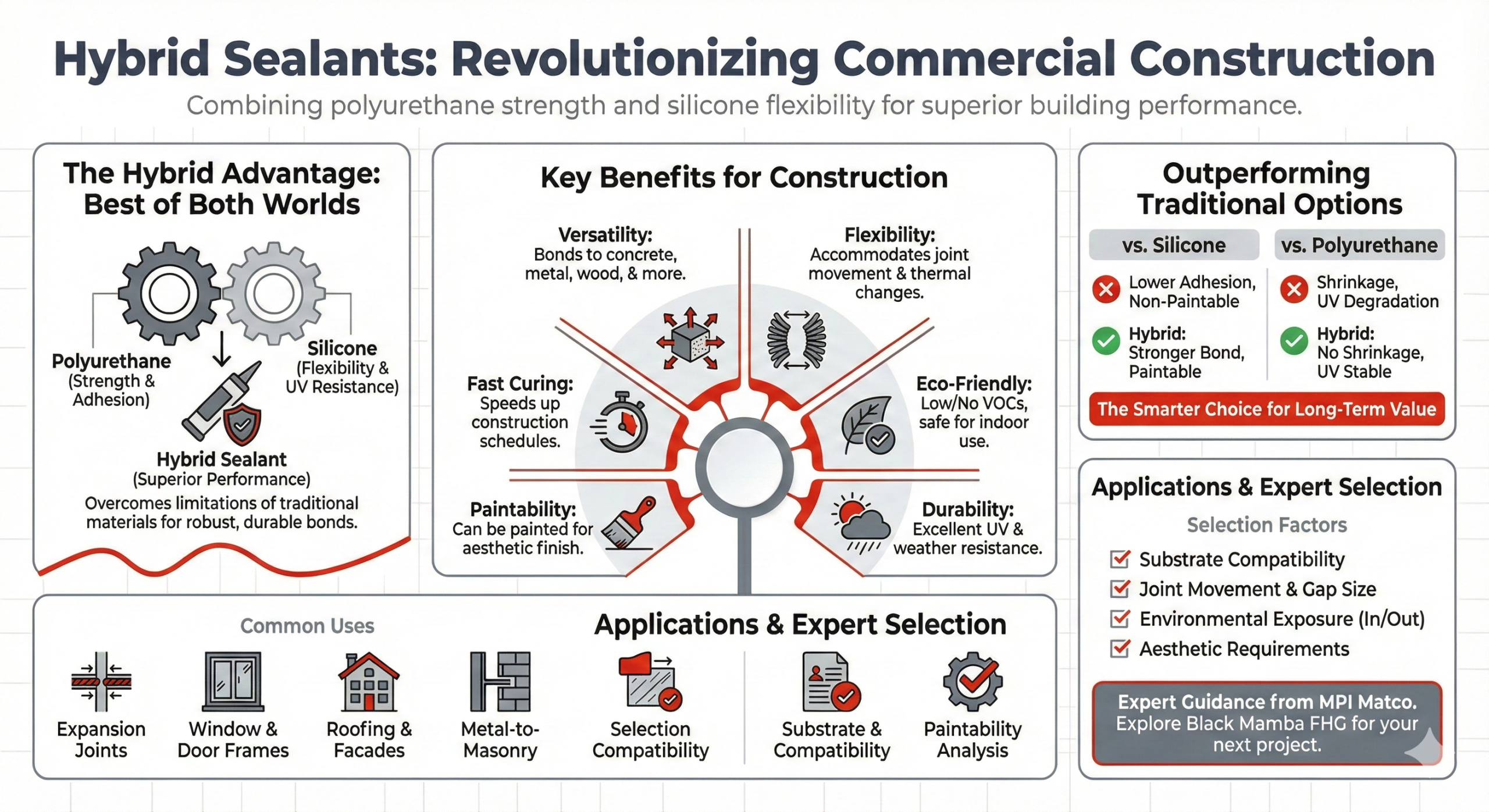
Hybrid sealants are a significant technological advancement, blending the best features of polyurethanes and silicones, a combination that effectively overcomes the limitations of these materials when used separately. They provide superior adhesion, movement capability, and durability, establishing themselves as a high-performance choice for diverse construction applications. Hybrid sealants, like MPI Matco’s Black Mamba, can replace a variety of traditional sealants and adhesives used on your construction projects, as well as mechanical fasteners such as screws, nails and staples.
Key Advantages of Hybrid Sealants
When it comes to commercial construction, there are many advantages to working with hybrid sealants. Here are just a few:
- Versatility: Hybrid sealants can be applied to various surfaces, from concrete to metal, and even over residual silicone materials. This adaptability makes them suitable for numerous applications, including window glazing and sealing expansion joints.
- Flexibility: They remain flexible after curing, which makes them ideal for applications that involve movement or temperature changes.
- Environmental Friendliness: With low or no volatile organic compounds (VOCs), hybrid sealants are ideal for sensitive environments like hospitals and schools. This aspect gains importance as VOC emission regulations become stricter.
- Durability: Hybrid sealants are designed to endure harsh weather, UV exposure, moisture and temperature extremes, ensuring a durable and tight seal without shrinking or cracking.
- Paintability: Unlike some traditional sealants (like silicone), many hybrid sealants can be painted over, making them a popular choice when aesthetics are important.
- Curing Time: Hybrid sealants generally have a faster curing time compared to some other sealants. This can help speed up construction and repair processes.
- Odour and Chemical Resistance: They often have a lower odour during application and can be resistant to chemicals, oils, and solvents, making them usable in different environments.
Performance Comparison with Traditional Sealants
Hybrid sealants cure upon exposure to moisture, ensuring thorough curing regardless of the application. They maintain excellent flexibility when fully cured, vital for accommodating building movements. Additionally, their UV stability prevents them from drying out and cracking over time.
Why choose hybrid sealants over traditional silicones?
Hybrid sealants outperform silicones with stronger adhesion to diverse materials, faster curing, and paintability for aesthetic finishes. Low odour, they are also environmentally friendlier, offering enhanced UV resistance and durability, making them ideal for versatile, long-lasting applications.
Why choose hybrid sealants over polyurethane sealants?
Polyurethane sealants, while useful, have limitations such as solvent-induced shrinkage leading to recessed joints and isocyanate-related blistering during curing. They also tend to underperform in weathering and UV resistance. In contrast, hybrid sealants overcome these drawbacks with no-shrink, blister-free formulations and superior weathering capabilities, making them a more robust and maintenance-friendly choice for long-term applications.
How to Choose the Right Hybrid Sealant for Your Building Project
When we help construction teams select a hybrid sealant, we focus on a few key factors:
Substrates and Surface Preparation
Are you sealing metal to masonry, glazing to frames, or interior finishes to drywall? Some hybrid sealants bond well to a wide range of materials, while others perform best on specific combinations or require a primer to ensure long-term adhesion.
Joint Movement and Gap Size
Expansion joints, window perimeters and façade elements all move differently over time. The amount of expected movement, the geometry of the joint, and the depth of the sealant bead will influence which hybrid sealant formulation is appropriate. A product that performs well on a static interior joint may not be suitable for an exterior façade joint that moves with temperature and wind loads.
Indoor vs Outdoor Exposure
Exterior joints that face rain, UV, freeze-thaw cycles and pollution require a sealant with proven weatherability, while interior applications may focus more on low odour and compatibility with finishes.
Regulatory and Environmental Requirements
Hospitals, schools and food-processing plants often demand low-VOC, low-odour products that support healthy indoor environments or green-building certifications. In some projects, green-building certifications also drive sealant selection.
Aesthetic Expectations
If the sealant will remain visible, colour options and paintability become important to architects and designers. Site conditions such as temperature, humidity and schedule pressure will guide whether you need a fast-skinning, fast-curing product like Black Mamba FHG, or a sealant with a longer open time for complex detailing.
Installation Conditions and Speed
Jobsite temperature, humidity and desired return-to-service time will narrow down the options. Faster skin and cure times matter when schedules are tight.
Our technical team at MPI Matco can work with you to recommend a hybrid sealant, such as Black Mamba FHG, that fits your performance and installation constraints.
Hybrid Sealant Applications in Commercial and Industrial Construction
Hybrid sealants are versatile for various construction scenarios, offering superior sealing and bonding for a wide range of materials such as concrete, brick, stone, metal, and wood. Their unique properties make them suitable for numerous applications including:
- Expansion Joints: Ideal for filling expansion joints in diverse materials like brick and wood.
- Window Re-glazing: Perfect for window applications due to their strong adhesion and UV resistance.
- Metal to Masonry: Suitable for sealing joints between metal and masonry, providing a weatherproof and durable bond.
- Windows and Doors Installation: Used for installing and sealing windows and doors, blocking drafts and leaks.
- Roofing Materials: Effective in sealing and bonding roofing materials, protecting against leaks and weathering.
- Architectural Elements: Bonds interior and exterior elements like panels, profiles, and decorative items, ensuring an aesthetically pleasing finish.
- Flooring Materials: Suitable for sealing and bonding various flooring materials, providing a stable and durable surface.
- Wall and Ceiling Coverings: Useful for bonding wall and ceiling coverings, contributing to the overall integrity and appearance of the structure.
- Plumbing and HVAC Systems: Ideal for sealing and bonding joints and seams, ensuring efficient and leak-free systems.
- Countertops and Backsplashes: Excellent for installing countertops, sinks and backsplashes, offering a durable bond that resists moisture and stains.
When Hybrid Sealants May Not Be The Best Choice
Hybrid sealants are versatile, but they are not the right answer for every situation. In environments with extreme temperatures, aggressive chemicals or continuous immersion, specialized sealants or elastomers may offer better long-term performance. They are also not a substitute for engineered structural joints or applications where building codes require specific products, such as fire-rated or intumescent sealants. In these cases, the best approach is to review the project requirements and, if needed, consider alternative technologies from our selection of structural adhesives.
In Conclusion
By fusing the strengths of polyurethanes and silicones, hybrid sealants represent a significant advance in the construction industry. These high-performance, environmentally-friendly sealants offer unrivaled versatility, enhancing the durability, safety and efficiency of construction projects such as yours. Ideal for a wide range of applications, from windows to plumbing, their superior adhesion, flexibility and resistance to environmental factors make them a preferred choice in building design and execution.
MPI Matco is a leading provider of industrial tapes and adhesives, offering multiple adhesive solutions and sealants for a wide range of industries. Discover Black Mamba FHG, our hybrid sealant solution, expertly designed for modern construction challenges. Embodying the latest advancements in sealant technology, this unique sealing solution offers enhanced performance for a variety of applications. Contact us to learn more about how Black Mamba FHG can contribute to the success of your projects.
Frequently Asked Questions About Hybrid Sealants
Are hybrid sealants suitable for exterior façades and curtain walls?
Yes, many hybrid sealants are formulated for exterior use and offer strong UV, weather and moisture resistance. The key is to choose a product that matches your substrates, joint design and environmental exposure.
Can hybrid sealants be painted?
One of the big advantages of hybrid sealants over traditional silicones is that many of them are paintable once cured. Always test compatibility with your paint system and follow the product’s surface preparation guidelines.
Can hybrid sealants replace mechanical fasteners in some applications?
In specific cases, a high-performance hybrid adhesive-sealant can reduce or eliminate screws, nails or staples. This needs to be evaluated case by case, considering load, safety factors and building codes. Our team can help review your application and advise you.
How long do hybrid sealants last in commercial construction?
Service life depends on exposure and joint design, but hybrid sealants are engineered for long-term durability in demanding environments when correctly selected and applied.
Other Articles That May Interest You

5 Key Factors to Consider When Selecting a Tape Converter
Are you confident that your adhesive tape converter aligns with...
LIRE PLUS
Benefits of Working with an Adhesive Tape Converter
Adhesive tape converting involves converting rolls of adhesive tape into...
LIRE PLUS